There is a continuation of my earlier entry detailing what I learned at the Michael Seewald Workshop. This section details the magic of cropping.
Once we had practiced how your eye moves, we worked on cropping. I rarely crop my images and have always felt they had to fit in to the dimensions of the standard print sizes. Michael Seewald actually spends a great deal of thought to cropping his images. To me, it was amazing to see how much improvement you can make with cropping. Start with 3 questions.
- What made you take the picture?
- What do you notice first? Is that what you wanted?
- What is strong and weak in the image?
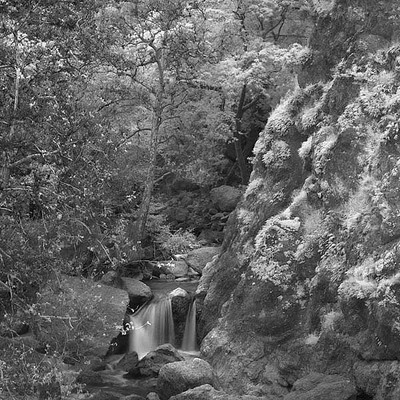
Here is a starting point of an infrared image taken recently in Sunol at the Little Yosemite area. Question 1: Why did I take the picture? Answer: I liked the waterfall with the rock wall as framing. Question 2: Is the waterfall my primary focal point?….
 DorothyPhoto